TL;DR

Get wellness gear delivered free with Prime
- Fast, free delivery on millions of items
- Prime Video, Amazon Music and more included
- Member-only deals all year
A Fit&Well contributor shared a home dumbbell workout built around four exercises performed in three rounds, with little equipment beyond one dumbbell and a sturdy support. The routine is presented as a time-saving way to train arms alongside the shoulders, back and core; the source does not report measured results or establish that it works for everyone.
A Fit&Well contributor has outlined a four-exercise arm workout for home, saying it fits into a schedule of three 30-minute sessions a week after longer gym visits became impractical. The routine uses one dumbbell for presses, rows and hammer curls, followed by a bodyweight triceps push-up; it is a personal account, not a reported trial of the workout’s results.
The contributor says their earlier training, undertaken while preparing for CrossFit competitions, could reach two hours a session, five times a week. They now train three times weekly for about 30 minutes, with the stated goal of maintaining strength and mobility. Combining push and pull movements in one session is their way of saving time rather than splitting arm work into separate workouts.
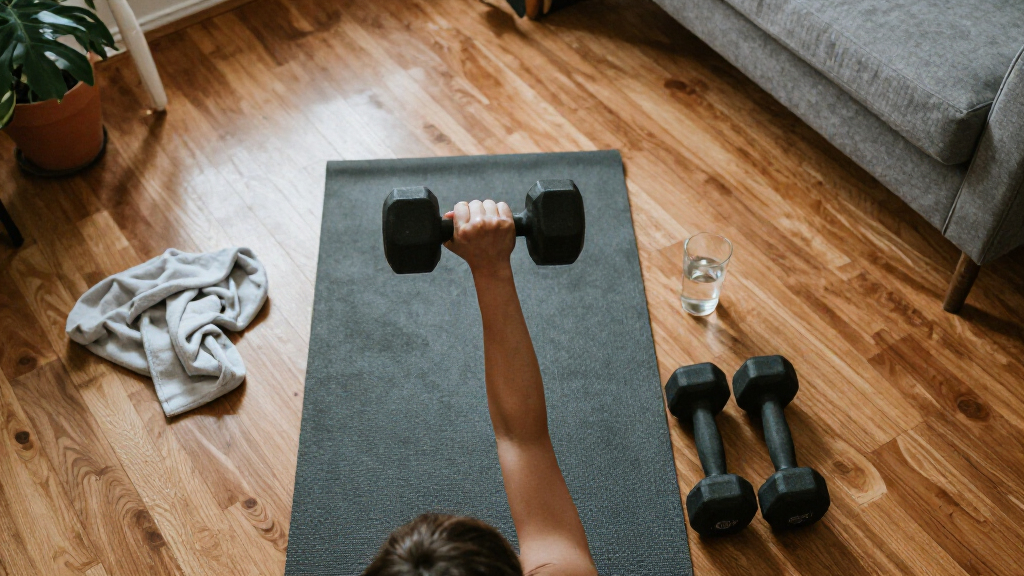
The sequence pairs a half-kneeling single-arm press with a single-arm bent-over row, then a single-arm hammer curl with a triceps push-up. The press and row are compound movements: they involve the shoulders and upper back as well as the arms. The contributor says that approach reflects how muscles work together during many everyday pushing and pulling tasks.
The prescribed volume is six to eight repetitions per side for each dumbbell exercise, followed by as many knee-based triceps push-ups as possible. After resting two minutes, the sequence is repeated for a total of three rounds. The contributor advises selecting a weight that makes the last repetitions challenging, increasing it slightly when eight repetitions become easy, and reducing it if eight cannot be completed.
A Shorter Format for Arm Training
The report offers readers a structured option for a limited schedule, using a short list of movements rather than separate push and pull sessions. Because the routine includes a row and overhead press, it is broader than an arms-only workout, recruiting the upper back and shoulders alongside the biceps and triceps.
That distinction matters when judging what the routine is designed to do. The contributor frames it as a way to maintain strength and mobility, not as a tested program for a particular level of muscle growth or fitness. No training data, comparison group or independently verified outcomes are provided, so readers should treat the claimed practical benefit as the writer’s experience rather than a guaranteed result.
The workout also requires more than the headline’s reference to dumbbells might suggest: a stable support, such as a table, is used for the row, while the final exercise relies on bodyweight. It may be adaptable for people with equipment at home, but the source does not assess accessibility for different abilities or injuries.
Products Worth Considering

Levoit Vital 100 Air Purifier for Home Bedroom

Bowflex SelectTech 840 Adjustable Kettlebell

Therabody Theragun Prime 6th Generation Deep Tissue Massage Gun, Black
As an affiliate, we earn on qualifying purchases.
From Long Gym Sessions to Home
The contributor describes a change in personal routine as life became busier: from lengthy training linked to CrossFit competition preparation to three shorter weekly sessions. The article’s focus is a single workout within that new schedule, not a claim that the routine replaces all gym training or addresses every fitness goal.
For the overhead press, the writer chooses a half-kneeling position. They say it removes leg assistance and momentum, engages the hips and lower core, and can reduce excessive arching in the lower back. The contributor also says they are recovering from a lower-back disc injury and find this adaptation suitable for themselves; that personal experience is not medical guidance for readers with back problems.
The equipment listed includes cast-iron spinlock dumbbells from Mirafit, which the source identifies as available in the U.K., and a similar set from CAP Barbell in the U.S. The instructions do not require those brands, but the workout does depend on having a weight that can be adjusted safely as strength changes.
““Now I do three 30-minute sessions a week to meet my goal of maintaining mobility and strength.””
— Fit&Well contributor
Results and Suitability Are Unverified
The article reports one person’s routine and does not provide measured outcomes, a training study, or a comparison with other programs. It is not clear how long the contributor has followed this exact sequence or what changes, if any, they have measured in strength, mobility or arm size.
The source also does not specify a rest period between exercises, beyond a two-minute rest after each round, or explain how to adapt the workout for people who cannot perform the prescribed movements. While the contributor describes the half-kneeling press as appropriate during their recovery, that does not establish its safety for other people with a back injury or other health concerns.
How Readers Can Apply the Routine
The source gives no announced follow-up or scheduled test of the workout. Its practical guidance is to begin with a manageable dumbbell load, use controlled repetitions and adjust the weight according to whether the prescribed range is too easy or too difficult. People should also make sure any support used for rows is stable.
Anyone with a current injury, pain or a health condition should seek advice from a qualified health professional before starting or modifying resistance training. The report presents the routine as the contributor’s personal approach; whether it fits another person’s goals, experience and physical needs remains individual.
Key Questions
What exercises are in the workout?
It consists of a half-kneeling single-arm press, a single-arm bent-over row, a single-arm hammer curl and a knee-based triceps push-up.
How many rounds does the source recommend?
The contributor recommends three rounds, resting two minutes after each round. The dumbbell movements are prescribed for six to eight repetitions per side; the push-up is done for as many repetitions as possible.
Does the workout need a gym?
No gym is specified. The routine uses one dumbbell and a sturdy support for the row, along with bodyweight for the push-up. The source does not say that the listed equipment brands are required.
Are results from this workout confirmed?
No measured results are reported. The routine is described through a contributor’s personal experience, so the source does not establish what results other people will get.
Is the half-kneeling press appropriate for back injuries?
The contributor says they use it while recovering from a lower-back disc injury, but that is not evidence that it is safe for everyone. People with an injury or health condition should ask a qualified health professional about suitable exercise.
Source: fitandwell.com