
TL;DR

Get wellness gear delivered free with Prime
- Fast, free delivery on millions of items
- Prime Video, Amazon Music and more included
- Member-only deals all year
Fit&Well reports that personal trainer Chris Browning recommends shoulder presses, squats, planks, dumbbell rows and glute bridges for beginners building strength at home. The suggested routine uses two to three sets per exercise, with repetitions or hold times adjusted to the movement; use light dumbbells and focus on form.
Fit&Well has outlined five exercises for people new to strength training at home, based on recommendations from personal trainer Chris Browning. The routine combines shoulder presses, bodyweight squats, planks, dumbbell rows and glute bridges, with suggested sets and repetitions to help beginners work several major muscle groups using limited equipment.
Browning, whom Fit&Well describes as having more than 20 years of experience creating home workouts, said he chose the movements because they are relatively simple to learn and can be progressed over time. The report recommends a pair of fairly light dumbbells for the shoulder press and row; the squat, plank and glute bridge use body weight.
The suggested plan is two to three sets of each exercise. The shoulder press, squat, row and glute bridge are prescribed for 10 to 15 repetitions; rows are performed on each side. For planks, the report suggests 30 to 60 seconds, while Browning advises beginners to stop when the position becomes challenging or uncomfortable, or when they can no longer keep good form.
The movements use different positions and patterns: pressing a weight overhead, bending at the hips and knees, holding a stable body position, pulling a weight toward the hip, and lifting the hips from the floor. Fit&Well recommends increasing the dumbbell weight once the exercises feel easy after a few weeks of practice. That is guidance from the report, not a guarantee of a particular strength or fitness outcome.
A Simple Starting Point at Home
The routine offers beginners a practical way to start resistance exercise without gym equipment or a complicated schedule. Its mix of upper-body, lower-body and core movements can help readers organize a basic session, while light dumbbells keep the equipment list limited.
For new exercisers, the emphasis on learning the movements before adding weight is relevant: an exercise is only useful if it can be performed with control. The source does not report clinical findings or compare this routine with other programs, so it should be read as a trainer’s guidance rather than proof that these are objectively the best exercises for every beginner.
Products Worth Considering

Levoit Eleva 300X HEPA Air Purifier for Home and Bedroom

Bowflex SelectTech 840 Adjustable Kettlebell

LEVOIT Vital 200S-P Smart Air Purifier for Large Rooms
As an affiliate, we earn on qualifying purchases.
How the Five Moves Fit Together
The routine pairs two dumbbell movements with three bodyweight exercises. The seated shoulder press trains an overhead pushing pattern; the row provides a pulling movement. Squats and glute bridges involve the legs and hips, while the plank challenges the ability to hold a braced position.
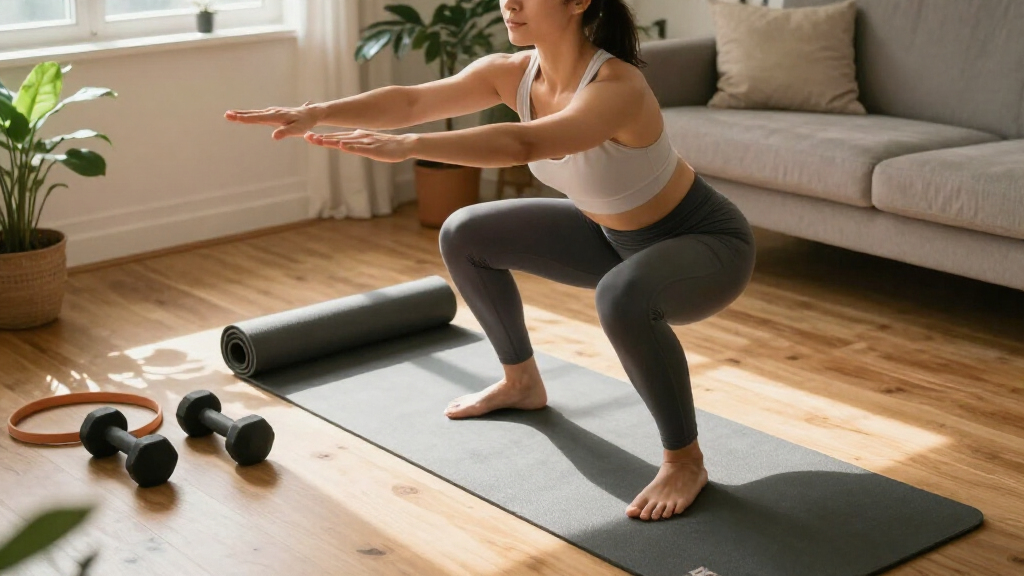
For the shoulder press, sit upright with a dumbbell in each hand at shoulder height, press the weights overhead without locking the arms, then lower them with control. For a squat, stand with feet roughly shoulder-width apart, lower only as far as comfortable while keeping the knees aligned with the toes, and return to standing. The report suggests extending the arms forward for balance if needed.
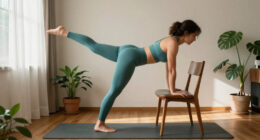
In a plank, place the elbows beneath the shoulders and maintain a straight line through the body while bracing the core and glutes. For a row, start on hands and knees, keep the back flat, draw one dumbbell toward the hip, lower it slowly, then switch sides after 10 to 15 repetitions. For a glute bridge, lie on the back with knees bent and feet flat, raise the hips until the body forms a line from chest to knees, then lower under control.
Limits of the Routine’s Evidence
The supplied report does not provide a publication date, evidence review, or comparison showing that these are the five best exercises against alternatives. It also does not specify how many days per week to train, how long to rest between sets, or how to adapt the plan for different abilities, injuries or medical conditions. Individual needs and safe starting loads vary, and the listed sets and repetitions are general recommendations rather than a personalized program.
The plank duration is presented as a range, but Browning’s quoted advice is to stop when form deteriorates or the position becomes uncomfortable. Readers should not treat 30 to 60 seconds as a target they must reach regardless of their ability. Anyone with a pre-existing condition, injury, or uncertainty about exercise should seek qualified professional guidance before starting or changing a routine.
Progress by Building Control
Beginners can first practice the movements with body weight or light dumbbells, choosing a range that allows them to keep steady form. The report advises moving to heavier weights only after the exercises feel easy following a few weeks of practice; it gives no fixed timetable or prescribed amount for each increase.
In the meantime, follow the listed set and repetition ranges as a starting point, and end a set if technique becomes difficult to maintain. The next step is not specified in the source: it does not offer a weekly schedule or rules for adding more exercises. People seeking a program tailored to their goals or health needs can ask a qualified trainer or health professional for guidance.
Key Questions
Which five exercises does the report recommend?
It lists the seated dumbbell shoulder press, bodyweight squat, plank, dumbbell row and glute bridge, based on personal trainer Chris Browning’s recommendation.
What equipment is needed?
The shoulder press and row use a pair of fairly light dumbbells. The squat, plank and glute bridge use body weight, so the routine requires little equipment.
How many sets and repetitions are suggested?
The report suggests two to three sets per exercise. It gives 10 to 15 repetitions for the shoulder press, squat, row and glute bridge, and a 30-to-60-second range for the plank. Rows are done on each side.
When should a beginner increase the weight?
Fit&Well says to consider increasing the dumbbell weight after practicing for a few weeks, once the exercises start to feel easy. The report does not specify an exact increase; maintain control and good form, and seek professional advice if unsure.
Source: fitandwell.com