
TL;DR
A Fit&Well report outlines four exercises—sit-to-stands with knee lifts, a dumbbell-supported leg raise, farmer carries and shoulder presses—for strength and balance in later life. The routine is presented as practical exercise guidance, not as evidence that these moves prevent falls or guarantee independence.
Fit&Well has published a four-move strength and balance routine from an instructor who teaches chair-based classes to adults in their late 60s through early 90s. The exercises use a sturdy chair and dumbbells to practise movements tied to daily tasks, such as standing from a seat, carrying groceries and reaching overhead.

Get wellness gear delivered free with Prime
- Fast, free delivery on millions of items
- Prime Video, Amazon Music and more included
- Member-only deals all year
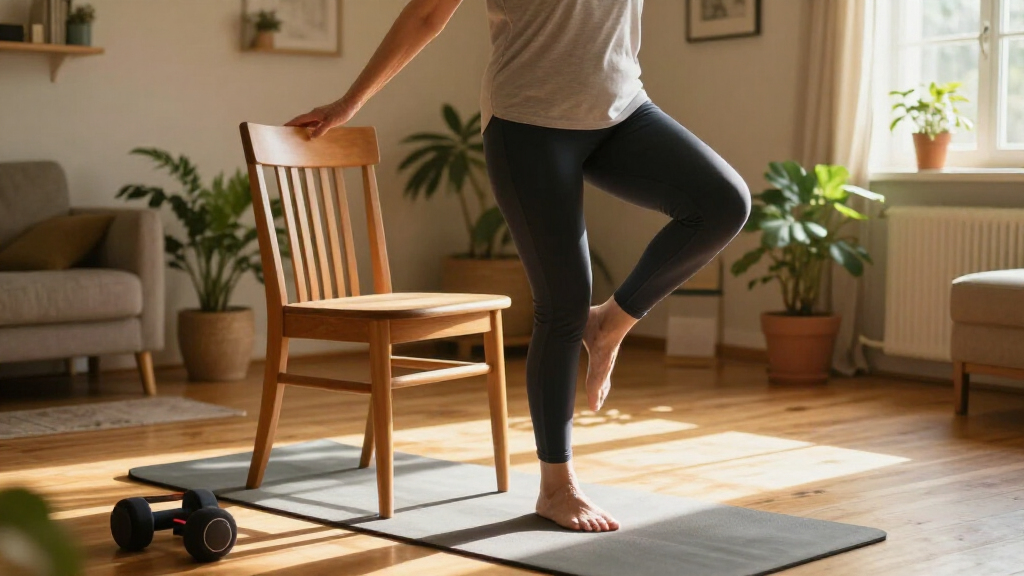
The routine pairs a seated knee lift with a sit-to-stand, then adds a standing leg raise while holding a dumbbell, a timed farmer carry and a shoulder press. The report recommends two rounds, with eight repetitions for each exercise—or eight per side where relevant—and a 30-second carry. It suggests resting for 30 seconds between farmer carries.
For the sit-to-stand combination, the exerciser sits near the front of a sturdy chair, lifts each knee in turn, then stands with both feet on the floor and lowers back down with control. The report says hands can be placed on the chair for balance if needed. For the leg raise, hold a dumbbell in one hand and lift the opposite leg out to the side without leaning; then switch sides.
For the carry, walk with a dumbbell in each hand while keeping the torso upright, then lower the weights by bending at the hips and knees. The shoulder press can be done standing or seated: press dumbbells from shoulder height overhead, keeping the torso steady and lowering the weights slowly. The report advises choosing weights that can be controlled throughout each movement.
Training for Everyday Tasks
The routine is organised around functional movements rather than a single fitness measure. Standing from a chair resembles getting up from a car seat; carrying weights resembles carrying shopping; and the overhead press practises lifting objects to a high shelf. The side leg raise challenges a person to keep steady while one leg moves.
That framing may help readers connect exercise with tasks they want to keep doing as they age. The instructor writes that class participants value being able to walk farther, get in and out of cars, carry groceries and reach overhead. Those are reported examples from the instructor’s experience, not results from a study of this specific four-exercise plan.
The report offers an accessible template, but it does not establish that the routine will prevent falls, restore mobility or produce the same results for everyone. People’s strength, balance, health and exercise experience vary, so the suggested repetitions and weights should not be treated as a universal prescription.
Products Worth Considering

BowFlex Results Series SelectTech Adjustable Dumbbells (Pair)

BowFlex Results Series 552 SelectTech Adjustable Dumbbell

Oral-B iO Series 3 Rechargeable Electric Toothbrush for Adults, Black, 3 Modes, 2 Brush Heads and Travel Case
As an affiliate, we earn on qualifying purchases.
How the Instructor Frames the Routine
The Fit&Well report is written from the perspective of a teacher of chair workout classes for older adults. The instructor says regular participants range from their late 60s to early 90s and attend with the aim of maintaining independence. The article uses anecdotes from those classes to explain why everyday strength matters.
Among the examples, the instructor says a client’s upper-body strength helped her get out of a hospital bed after a hip replacement, while another found it easier to get in and out of her daughter’s car. A third, the instructor writes, could swim longer and walk farther to a bus stop without a walking stick. These accounts are personal observations; the source does not provide clinical records or evidence that this routine caused the changes.
The instructor also recommends starting strength work in one’s 40s and 50s as preparation for later life. The article presents that as advice, while the listed exercises and claimed benefits are not accompanied by a research review, study data or a comparison with other programs.
Evidence and Individual Suitability
The report does not identify a study testing these four exercises as a combined program, specify how long people should follow it, or quantify likely changes in strength or balance. It also does not give evidence that the routine reduces falls or improves health outcomes. The participant stories are attributed anecdotes, and the source does not establish that the exercises alone produced those outcomes.
Readers’ ability to do the movements safely may differ. The article recommends a sturdy chair and controllable weights, but it does not provide individual modifications for pain, limited mobility, balance difficulties or existing medical conditions. Anyone uncertain about starting or changing an exercise routine—particularly people with health conditions or a recent operation—can seek guidance from a qualified health professional. The source does not state whether the instructor’s routine has been clinically reviewed.
Adapting the Moves Safely
The source gives a suggested format—two rounds, eight repetitions per move or side, and 30 seconds per farmer carry—but does not set out a progression plan or a schedule for repeating the workout. It is also unclear whether Fit&Well plans to publish follow-up reporting, participant outcomes or expert review of the routine.
For readers considering the exercises, the immediate practical step is to start with weights they can control, use a stable chair for support where needed and stop if a movement feels unsafe or causes concerning discomfort. People with pre-existing conditions, recent surgery or significant balance concerns should ask a qualified professional for individualized advice before attempting the routine.
Key Questions
Which four exercises does the report recommend?
The routine includes a seated knee lift and sit-to-stand, a dumbbell hold with a side leg raise, a farmer carry and a shoulder press.
How many repetitions are suggested?
The report suggests two rounds and eight repetitions of each exercise, doing eight on each side where relevant. Farmer carries are timed for 30 seconds, with 30 seconds of rest.
What equipment is needed?
A sturdy chair and a pair of dumbbells are listed. The instructor advises using weights that remain comfortable to control throughout each movement.
Does the report show that these exercises prevent falls?
No. It presents the moves as a practical strength and balance routine, but provides no study results or evidence that this specific plan prevents falls. The benefits described include instructor-reported examples from class participants.
Source: rss