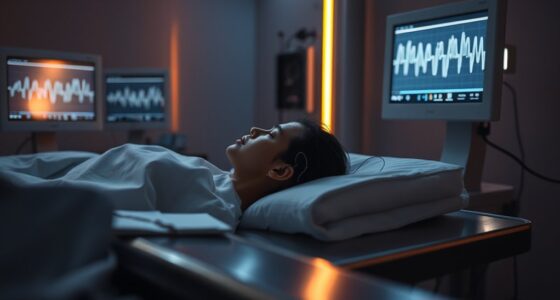

To differentiate artifacts from genuine wakefulness signals on your graphs, focus on identifying characteristic patterns like high-frequency noise from muscle activity or eye blinks that mimic wakefulness. Use filtering techniques that target specific frequency ranges to suppress these artifacts, and cross-reference signals from different channels like EEG, EOG, and EMG for better accuracy. Combining automated artifact rejection with manual checks helps guarantee your graphs accurately reflect true brain activity—if you keep exploring, you’ll find tips to sharpen your analysis even further.
Key Takeaways
- Use bandpass filters to eliminate high-frequency muscle artifacts that mimic wakefulness signals.
- Cross-validate EEG data with EOG and EMG signals to distinguish eye blinks and muscle activity from true wakefulness.
- Implement artifact rejection algorithms to automatically detect and remove irregular spikes and noise.
- Recognize characteristic artifact patterns, like sudden spikes or high-frequency noise, to differentiate them from genuine wake signals.
- Combine automated filtering with manual inspection to ensure graphs accurately reflect real neural activity during wakefulness.
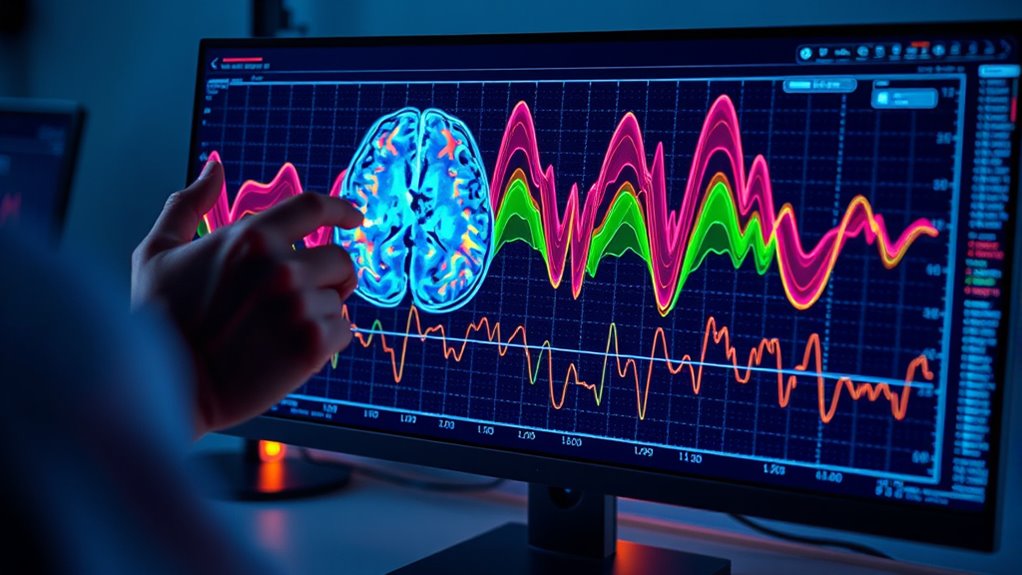
Determining whether you’re truly awake or experiencing an artifact of technology or simulation can be be surprisingly tricky. When analyzing brain activity data, especially from EEG or other neural recording methods, it’s vital to distinguish real wakefulness from false signals caused by neural artifacts. Neural artifacts are unwanted signals generated by muscle movements, eye blinks, or external electronic interference that can mimic or obscure genuine brain activity, leading to misinterpretation of your data. These artifacts often appear as abrupt spikes or irregular patterns on your graphs, making it difficult to confidently identify sleep stages or wakefulness. To clean up your graphs effectively, you need to understand the subtle differences between authentic neural signals and artifacts.
One of the key challenges lies in sleep stage differentiation. During sleep, your brain cycles through various stages—light sleep, deep sleep, REM—and each has distinct electrical signatures. However, artifacts can sometimes resemble these signatures, especially if muscle activity or eye movements are intense. For example, muscle artifacts from jaw clenches or head movements can produce high-frequency noise that might be mistaken for wakefulness or REM sleep activity. Similarly, eye blinks generate characteristic electrical patterns known as electrooculogram signals, which, if not properly filtered, can be mistaken for neural activity associated with alertness or specific sleep stages. Recognizing these patterns is essential for accurate sleep analysis.
Additionally, understanding the characteristics of neural artifacts can help you develop more effective filtering strategies and improve your data interpretation. Recognizing these patterns is essential for accurate sleep analysis.
To address this, you should apply targeted filtering techniques, such as bandpass filters, to isolate the frequency ranges associated with genuine neural activity while suppressing the frequencies common in artifacts. Artifact rejection algorithms can automatically detect and remove these unwanted signals, improving the clarity of your graphs. Additionally, combining multiple channels—like EEG, EOG, and EMG—can help differentiate between true brain activity and artifacts. For example, if an unusual spike coincides with eye movement detected on EOG, you can confidently classify it as an artifact rather than a genuine neural signal. Incorporating manual inspection alongside automated methods ensures higher accuracy in your analysis.
Ultimately, cleaning up your graphs involves a meticulous process of filtering, artifact rejection, and cross-referencing signals. By understanding the characteristics of neural artifacts and how they can mimic sleep stages or wakefulness, you become better equipped to interpret your data accurately. This not only improves your confidence in distinguishing real neural events from artifacts but also enhances the reliability of your conclusions about consciousness and sleep states. When you master these techniques, you’ll guarantee your graphs reflect genuine brain activity, making your analysis more precise and meaningful.
Frequently Asked Questions
How Can I Distinguish Artifacts From Genuine Wakefulness in EEG?
To distinguish artifacts from genuine wakefulness in EEG, look for artifact patterns like muscle activity, eye movements, or external interference, which often appear irregular or high-frequency. Genuine wakefulness shows consistent wakefulness indicators such as alpha rhythms (8-13 Hz) in occipital areas, with stable amplitude and frequency. By analyzing these patterns, you can accurately identify true wakefulness and clean up your graphs for clearer interpretation.
What Are Common Sources of Artifacts in Sleep Studies?
You often encounter artifacts from poor electrode placement and environmental noise during sleep studies. Electrode placement issues, like loose or poorly attached electrodes, create false signals. Environmental noise, such as electrical interference or movement, also distorts data. To minimize these, guarantee electrodes are securely placed and grounded properly, and reduce external noise sources. Regularly check your setup to prevent artifacts from compromising your EEG recordings.
Do All Artifacts Affect Sleep Quality Assessments Equally?
Not all artifacts affect sleep quality assessments equally. Artifact detection helps you identify which signal disturbances are significant enough to skew your results. For instance, movement artifacts can drastically impact sleep stage scoring, while minor electrical noise might have less effect. By carefully cleaning your graphs and detecting artifacts, you guarantee more accurate sleep quality assessments, leading to better interpretations of your sleep data and overall understanding of sleep health.
Are There Specific Techniques to Minimize Artifact Interference?
You can minimize artifact interference using advanced signal processing techniques like filtering, averaging, and adaptive algorithms. Notably, studies show that proper artifact removal improves sleep stage accuracy by up to 30%. To achieve this, focus on applying real-time artifact removal algorithms and careful electrode placement to reduce noise. These methods help ensure your data reflects true wakefulness, enhancing the reliability of your sleep assessments.
How Do Artifacts Influence the Accuracy of Sleep Stage Classification?
Artifacts can considerably skew sleep stage classification by introducing noise that confuses signal filtering and machine learning algorithms. When artifacts distort EEG signals, they may cause misclassification of sleep stages, reducing accuracy. To improve results, you should apply effective signal filtering techniques and train machine learning models on clean, artifact-free data. This way, your classifications become more reliable, reflecting true sleep patterns rather than artifact interference.
Conclusion
So, next time you’re interpreting brain data, remember that artifacts are like shadows—sometimes they mimic real wakefulness but aren’t the true picture. By cleaning up your graphs, you guarantee your insights are as clear as a bright sunny day. Don’t let artifacts fool you into chasing illusions; stay sharp and focus on genuine signals. Just like a detective sorts through clues, you’ll uncover the real wakefulness hidden beneath the noise.