
TL;DR

Get wellness gear delivered free with Prime
- Fast, free delivery on millions of items
- Prime Video, Amazon Music and more included
- Member-only deals all year
Alina Boyett, founder of UK-based Yogalina Studios, shared a beginner-friendly, four-movement yoga flow intended to support gentle recovery after exercise or time spent sitting. The sequence takes no equipment and uses short, breath-counted holds; Boyett advises moving comfortably and avoiding pain.
UK yoga teacher Alina Boyett, founder of Yogalina Studios, has shared a four-pose recovery flow that can be done at home without equipment, offering beginners gentle movement after a workout, a run or a day of sitting. The Fit&Well report presents the sequence as a way to slow down and stretch, not as a treatment for injury or a substitute for medical advice.
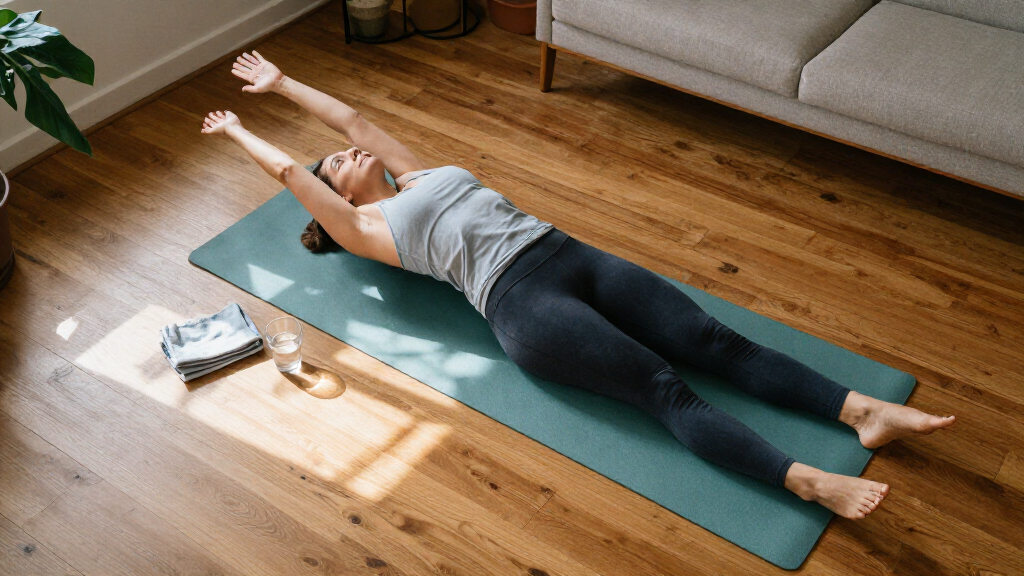
The routine covers the legs, hips, spine and shoulders through Waterfall pose, Child’s pose, a Ragdoll forward fold and a seated spinal twist. The instructions use brief holds measured in breaths: three to five breaths for the first three poses, with the fold and twist repeated as specified. The seated twist is held for two to three breaths on each side.
Boyett says the movements were selected to address areas that commonly feel tense after exercise. Her guidance is to move slowly within a comfortable range, soften the knees where useful and avoid forcing any position. The poses do not require advanced flexibility or prior yoga experience, according to the report.
For Waterfall pose, the participant lies near a wall and rests both legs against it, bending the knees slightly if needed. Child’s pose begins on hands and knees, with the hips lowering toward the heels. The standing fold uses soft knees and a relaxed upper body. In the seated twist, the torso rotates gently to each side without being pulled further into the turn.
A Short Routine for Recovery
The report’s practical point is that recovery can include gentle movement, rather than only complete rest. The routine is brief and equipment-free, so readers can try it at home after ordinary activity, including prolonged desk work. It also offers a structured alternative to pushing through a hard workout when the body needs a slower pace.
These are instructional and wellness claims, not measured findings about outcomes. The source does not provide a study showing that this specific sequence improves flexibility, speeds recovery or reduces pain. Boyett describes possible effects such as easing tension and helping tired legs feel less heavy; those descriptions should be understood as her guidance, not a guaranteed result for every person.
Products Worth Considering

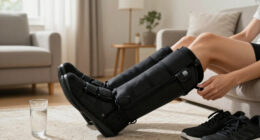
Hyperice Normatec Elite Wireless Compression Boots

Withings Body Smart Wi-Fi and Bluetooth Body Composition Scale

Oral-B iO Series 7 Rechargeable Electric Toothbrush with 2 Brush Heads and Charging Travel Case
As an affiliate, we earn on qualifying purchases.
Four Poses, No Equipment
The Fit&Well report frames the flow around the balance between exercise and recovery. Boyett says people often focus on training volume or intensity while overlooking time to recover. She recommends approaching recovery deliberately, while stressing that it need not mean doing nothing.
The sequence is presented as adaptable to different points in a day: after a challenging session, a run or extended sitting. Its holds are short and guided by breathing rather than a fixed timed workout. The article also includes demonstrations by Yogalina teacher Misha Clarke; the supplied material does not provide further details about the video or its publication date.
Benefits Are Not Measured
The supplied report does not cite research testing this exact four-pose flow, quantify flexibility changes or establish how quickly participants might feel an effect. Boyett’s comments about relaxation, tension and the sensation of heavy legs are her stated rationale for the movements, not confirmed outcomes for all users.
The source also gives no detailed modifications for particular injuries, pregnancy or medical conditions. It advises professional guidance for people with an injury or relevant condition, and says not to push through pain. Readers should stop if a pose causes pain or feels unsafe rather than treating the sequence as a prescribed exercise plan.
How to Try the Sequence
The report offers the routine as a home practice that readers can follow at their own pace: begin with the supported leg position, continue through Child’s pose and the forward fold, then finish with a seated twist on both sides. Keep each hold within the suggested breath count and use a wall for support in Waterfall pose.
No follow-up study, clinical evaluation or further publication milestone is identified in the source. For now, the next step for readers is simply to treat the flow as optional, gentle movement, adapt or skip any uncomfortable pose and seek professional advice before trying it when an injury or medical condition may affect safe participation.
Key Questions
What does the beginner-friendly yoga flow include?
It includes Waterfall pose, Child’s pose, a Ragdoll forward fold and a seated spinal twist. The report gives short holds of a few breaths for each movement.
Do I need yoga equipment?
The sequence is described as requiring no equipment. Waterfall pose uses a wall for support; the other movements are done on the floor or standing.
When does Boyett suggest doing the flow?
Boyett suggests it as gentle movement after exercise, a run or a day spent sitting. The report does not prescribe a particular schedule or say it must be done daily.
Is the routine proven to improve flexibility or speed recovery?
The supplied report does not cite research measuring those outcomes for this sequence. Boyett describes the poses as intended to support relaxation and address common areas of tension, but results are not guaranteed.
Who should seek advice before trying the poses?
Boyett advises anyone with an injury or relevant medical condition to seek appropriate professional guidance first. The instructions also say not to force a stretch or continue through pain.
Source: fitandwell.com