
TL;DR

Get wellness gear delivered free with Prime
- Fast, free delivery on millions of items
- Prime Video, Amazon Music and more included
- Member-only deals all year
A 2026 review pooling 33 studies and 519 athletes found beet juice was associated with modest improvements in aerobic capacity and somewhat larger, though still modest, improvements in high-intensity performance and power. Dietitian Theresa Gentile says dose and timing matter; the findings do not establish that every beet product or serving will improve a workout.
A 2026 review of 33 studies found that beet juice may modestly improve aerobic capacity and may offer somewhat larger, though still modest, gains in high-intensity performance and power. The review covered 519 professional and amateur athletes, but the findings do not mean that any beet juice product or dose will reliably boost every person’s workout.
The review pooled research involving athletes across a range of sports. According to the report in Fit&Well, the researchers found a modest improvement in aerobic capacity, alongside somewhat larger but still modest effects on anaerobic exercise performance and power output. The report says findings were consistent across the studies, though it does not provide study-by-study results or explain the review’s methods in detail.
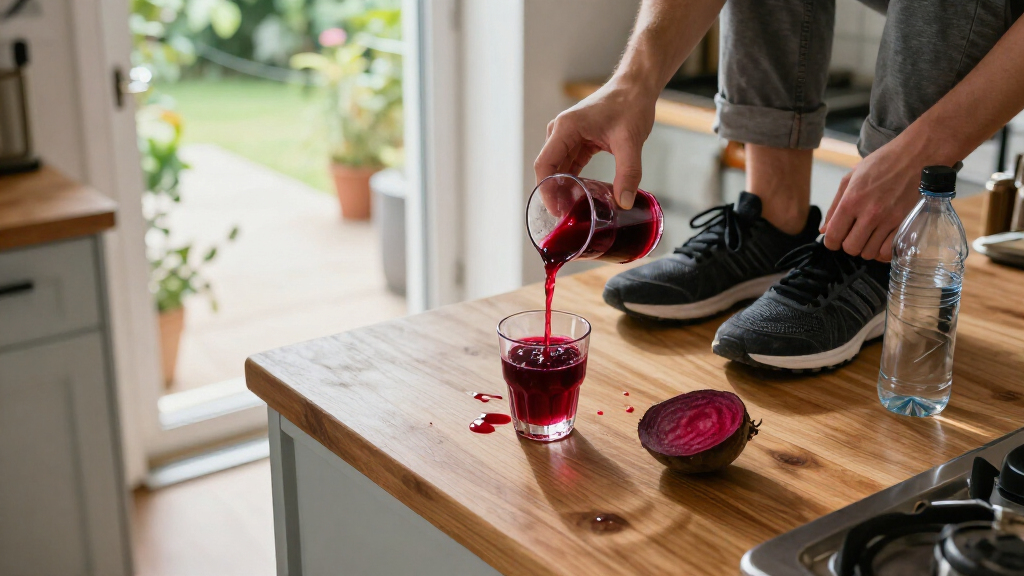
Registered dietitian nutritionist Theresa Gentile, a spokesperson for the Academy of Nutrition and Dietetics, told the publication that beet juice contains dietary nitrate, which the body converts into nitric oxide. Nitric oxide can widen blood vessels and affect blood flow and muscle oxygen use. Those mechanisms may help explain a performance effect, but they do not guarantee a noticeable change for an individual athlete.
Gentile said research commonly uses 5–9 millimoles of nitrate, about 300–600 milligrams. She also cited evidence suggesting 8.3–16.4 millimoles, or about 515–1,017 milligrams, may produce greater benefits. The report cautions that nitrate levels vary by product: sports-specific shots may provide a standardized dose, while ordinary grocery-store shots and juice can contain widely differing amounts.
What the Results Suggest for Training
The review adds evidence that beet juice could support more than steady endurance activity: the reported effects were also seen in high-intensity performance and power. That distinction may interest people whose training includes short, demanding efforts as well as longer aerobic sessions.
Still, the findings describe modest average effects, not a guaranteed or dramatic improvement. The potential value for readers is practical rather than transformative: beet juice may be one option to test alongside established training and nutrition habits, but results can depend on the nitrate dose, the product and the person. The source does not establish that beet juice replaces training, a balanced diet or other performance strategies.
beetroot juice shots standardized nitrate dose for athletes
As an affiliate, we earn on qualifying purchases.
As an affiliate, we earn on qualifying purchases.
How Nitrate Dose and Timing Fit
Beets are a source of dietary nitrate. In the explanation Gentile gave Fit&Well, the body converts nitrate into nitric oxide, a molecule associated with blood vessel widening and blood flow. The report presents this as a possible explanation for the exercise findings, rather than proof that the mechanism will produce the same result for everyone.
For timing, Gentile said research suggests consuming beet juice two to three hours before exercise, when nitric oxide levels may be near their peak. Some studies also report benefits from daily intake for at least three days before an event, although she described a pre-exercise dose as the more practical and consistently effective approach. For morning exercisers, that timing may be difficult to follow.
The report also notes possible cardiovascular effects from beet juice and other nitrate-rich vegetables, including arugula and spinach. Gentile said these foods may support blood vessel function and modestly lower blood pressure, particularly among people with hypertension, but she said more research is needed on long-term dosing and benefits beyond a vegetable-rich diet.
“Beet juice is rich in dietary nitrate, which is converted in the body into nitric oxide.”
— Theresa Gentile, registered dietitian nutritionist and Academy of Nutrition and Dietetics spokesperson
high nitrate beetroot juice powder pre workout
As an affiliate, we earn on qualifying purchases.
As an affiliate, we earn on qualifying purchases.
What the Review Cannot Settle
The reported results do not establish how much an individual will benefit, which sports or fitness levels respond most, or whether a particular product contains an effective nitrate dose. The source describes the pooled review but does not provide its full methods, the range of effects among participants, or enough detail to assess how the studies differed.
It is also unclear from the report whether higher doses consistently outperform the lower research range; Gentile said some recent evidence points that way, not that a higher amount is proven best. The optimal long-term dose and any additional benefit from routine supplementation beyond a healthy, vegetable-rich diet remain unsettled. Readers should check product nitrate information rather than assume that all beet shots are equivalent.
beetroot juice concentrate sports nutrition 300 mg nitrate
As an affiliate, we earn on qualifying purchases.
As an affiliate, we earn on qualifying purchases.
What Athletes Can Check Before Trying
The next practical step for anyone considering beet juice is to review the product’s stated nitrate content and compare it with the doses discussed in the research, rather than relying on serving size alone. The report’s guidance is to take a dose two to three hours before exercise; it also describes daily use for at least three days before an event as supported by some studies. These are research-based suggestions, not a promise of improved performance.
Further research is needed to clarify long-term use, the best dose for different athletes and whether routine supplementation adds value beyond dietary sources of nitrate. The source does not report a new trial or a forthcoming research milestone, so no specific next publication or event is confirmed.
beetroot juice powder for endurance training
As an affiliate, we earn on qualifying purchases.
As an affiliate, we earn on qualifying purchases.
Key Questions
Does beet juice improve workout performance?
A review of 33 studies involving 519 athletes reported modest improvements in aerobic capacity and somewhat larger, though still modest, benefits for high-intensity performance and power. It does not guarantee that every person will notice an effect.
How much nitrate did the research use?
Dietitian Theresa Gentile said most research suggests 5–9 millimoles of nitrate, about 300–600 milligrams. She cited some recent evidence suggesting 8.3–16.4 millimoles, or about 515–1,017 milligrams, may produce greater benefits; the best dose is not settled.
When should I drink beet juice before exercise?
Gentile said research suggests taking it two to three hours before exercise. Some studies have also examined daily intake for at least three days before an event, but the source describes the single pre-workout dose as the more practical and consistently effective strategy.
Are all beet shots likely to have the same effect?
No. The report says nitrate content varies among ordinary beet juices and grocery-store shots. Gentile said sports-specific shots may offer a standardized dose, so readers should check a product’s nitrate information rather than assume all servings are comparable.
Does the review prove beet juice has long-term health benefits?
No. Gentile said nitrate-rich foods may support blood vessel function and modestly lower blood pressure, particularly for people with hypertension, but she also said more research is needed on optimal long-term dosing and benefits beyond a healthy, vegetable-rich diet.
Source: rss
Halloween Picks
halloween
As an affiliate, we earn on qualifying purchases.