TL;DR

Get wellness gear delivered free with Prime
- Fast, free delivery on millions of items
- Prime Video, Amazon Music and more included
- Member-only deals all year
A Fit&Well report describes three coordination exercises a trainer incorporates into sessions with older adults: opposite-arm knee raises, side step-outs with an opposite-arm reach, and a ball-throwing drill. The exercises can be adapted for seated or standing practice, but the report does not establish that this specific routine extends life or prevents falls.
Fit&Well has published a trainer’s account of three coordination exercises used in classes and personal training sessions with older adults, with seated options for people who do not exercise standing. The report presents the movements as ways to practise coordination and controlled movement, not as a proven method to extend lifespan or prevent falls.
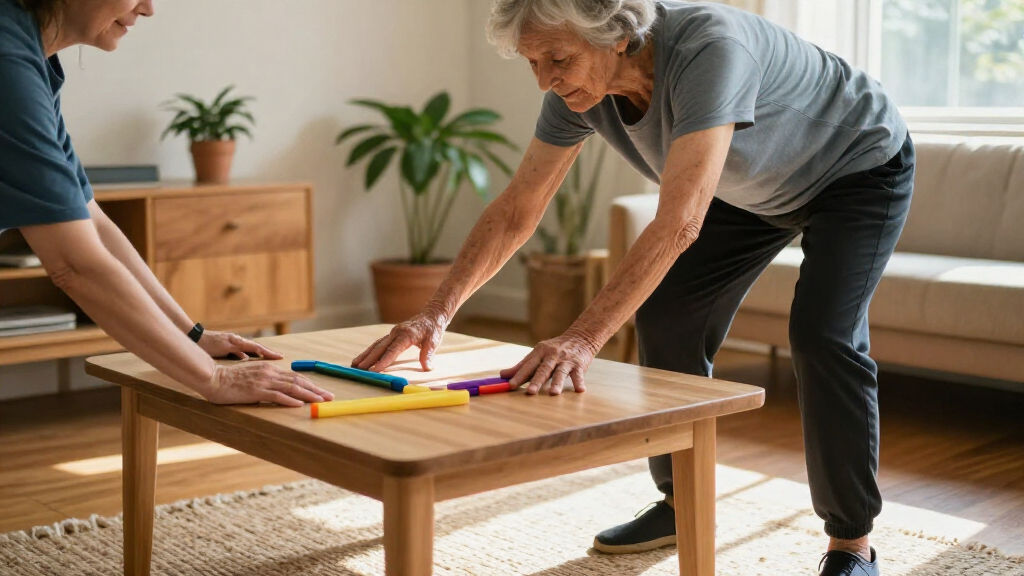
The trainer says coordination work is included in chair-based yoga classes and personal training sessions. The three examples are a knee raise paired with the opposite arm, a side step paired with an opposite-arm reach, and a ball throw and catch while balancing. The first two are suggested for five to six repetitions per side; the ball drill is listed for five to 10 repetitions.
For the first exercise, a standing participant raises one knee while bringing the opposite arm forward, then switches sides. The seated version is a controlled march, with the opposite arm lifted overhead or in front. For the second, the participant steps to the side and reaches forward with the opposite arm; the report says a side lunge is optional. Seated participants can step one foot out and open the opposite arm to the side.
The third drill involves tossing a ball gently against a wall and catching it while standing on one foot. The report suggests changing the throw direction or using one or two hands to adjust the challenge. It also offers less demanding versions: stand on both feet, do the activity seated, or use a different ball size. These are exercise suggestions from the report, not individualized medical advice.
Coordination in Everyday Movement
The exercises pair movement on one side of the body with movement on the other, asking participants to coordinate limbs and, in the ball drill, respond to a moving object. That makes the routine relevant to older adults who want to practise controlled movement and balance in a structured setting. The trainer links these skills to daily activities such as moving around other people or managing tasks at home; that connection is the trainer’s rationale, rather than a measured outcome reported for these particular exercises.
The seated adaptations also show how the same general task can be adjusted for different mobility levels. A person may practise timing and coordination without standing, while someone comfortable on their feet can add a side step or balance challenge. Readers should not treat the variations as equally suitable for everyone: balance ability, pain, health conditions and surroundings can affect whether a movement is appropriate.
Products Worth Considering

Oral-B iO Series 3 Rechargeable Electric Toothbrush for Adults, Black, with 2 Brush Heads and Travel Case

Withings Sleep Under-Mattress Sleep Tracking Pad

Theragun Mini 3rd Generation Massage Gun – Travel Essential (Black)
As an affiliate, we earn on qualifying purchases.
How the Trainer Adapts the Drills
The report distinguishes coordination training from strength training, noting that the trainer uses both kinds of activity with older clients. Its examples emphasize opposite-side arm and leg patterns, alongside options to practise seated or standing. For some clients, the trainer combines standing coordination movements with balance exercises; others do the movements seated.
The report also refers to a 2019 review of balance and coordination exercises in older adults. It says the review found possible improvements in cognitive processes such as spatial awareness, as well as postural control and stability in distracting environments. The source does not give the review’s title, number of participants or effect sizes, so those details cannot be evaluated from the report alone. The review’s general findings should not be read as proof that these three specific drills produce the same results.
““I always incorporate coordination training into my chair-based yoga classes and personal training sessions with older adults.””
— The trainer quoted in the Fit&Well report
Evidence and Individual Suitability
The source report does not provide research showing that its three listed exercises independently improve cognition, prevent falls, or lengthen life. It summarizes a 2019 review but does not identify the review or supply enough information to assess how strong or applicable its findings were. The trainer’s descriptions of clients becoming sharper, more agile or more confident are presented as the trainer’s experience, not as outcomes measured in a study.
It is also unclear how often the exercises should be performed, how long a session should last, or how progress should be measured. The report does not give individualized guidance for people with balance problems, recent injuries, or health conditions. Anyone unsure whether a standing drill is suitable should ask a qualified health or exercise professional; use a stable support and clear area, and stop if the activity causes pain, dizziness or unusual shortness of breath.
Choosing a Suitable Starting Version
The report offers options rather than a prescribed progression. A reader interested in trying the movements can begin with a seated variation or two-foot stance, use slow, controlled movements, and add a standing balance challenge only if it feels manageable. The ball drill should be done with a light, gentle throw and enough clear space; a wall and nearby support may help reduce hazards.
No follow-up study, clinical guidance or further reporting is identified in the source. Readers seeking a routine tailored to their needs can consult a physiotherapist or qualified exercise professional, particularly if they have a condition that affects balance or mobility. The report’s next practical step is therefore individual adaptation, not a one-size-fits-all program.
Key Questions
Which coordination exercises does the report describe?
It describes an opposite-arm knee raise, a side step with an opposite-arm reach, and a ball throw-and-catch drill. The source lists five to six repetitions per side for the first two and five to 10 repetitions for the ball exercise.
Can the exercises be done seated?
Yes. The report suggests a seated march with an opposite-arm lift, a seated side step-out with the opposite arm opening to the side, and a seated version of the ball activity. Choose a version appropriate to your ability.
Does this routine prove coordination exercises prevent falls?
No. The report refers to a 2019 review of balance and coordination exercises, but it does not provide evidence that these three specific drills prevent falls. The source also does not give enough detail about the review to assess its findings fully.
What safety steps should older adults take?
Start with a manageable variation, clear the surrounding area and use support if needed. Anyone with mobility or balance concerns, an injury, or a health condition should seek advice from a qualified professional before trying standing balance drills.
Source: rss